
STAFFORD surname concentrated in Derbyshire and Greater Manchester in 1841 and 1851
The online availability of UK census data and the provision of search tools have facilitated the tracing of families back to 1841. However, getting further back in time requires more exacting searches in church parish records and, when common Christian names are used, there is no certainty that the correct individual has been found. Although many more church records are coming online, they are far from complete and manual searches are required. Knowing where to start the search is key. Unfortunately, the specific county of birth was not recorded in the 1841 census, if it were outside the enumerated location. More information e.g., place of birth was recorded in the 1851 census, but the information was not always correctly stated or recorded. One strategy is to focus the search on areas that have a high frequency of the target surname. Surname mapping is one way of locating these areas.
Subject to certain caveats, a clear concentration of the STAFFORD surname was recorded for both the 1841 and 1851 census in Derbyshire and what is now the Greater Manchester area. In both cases the majority of individuals were born in the county, particularly for Derbyshire where only 7% were born outside the county in 1841. In 1851, of those born outside Derbyshire some 90% originated in the surrounding counties, in particular Cheshire. Of all the STAFFORDs recorded in England and born in Derbyshire, 78% of them still lived there in 1851. The data suggest that in this timeframe the majority of STAFFORD families were not very mobile and if a family can be traced back to Derbyshire there is an excellent chance that Derbyshire is their ancestral home.
STAFFORD Surname Distribution
The distribution of STAFFORD surnames in the 1841 census is shown in Figure 1 and for 1851 in Figure 2: the darker the colour the greater the number of people with the surname STAFFORD.
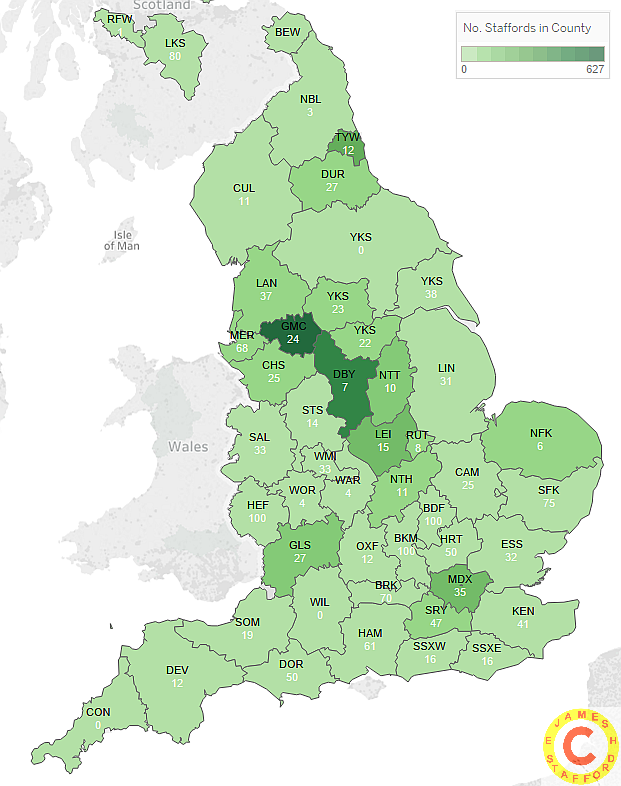 Figure 1. 1841 STAFFORD Distribution
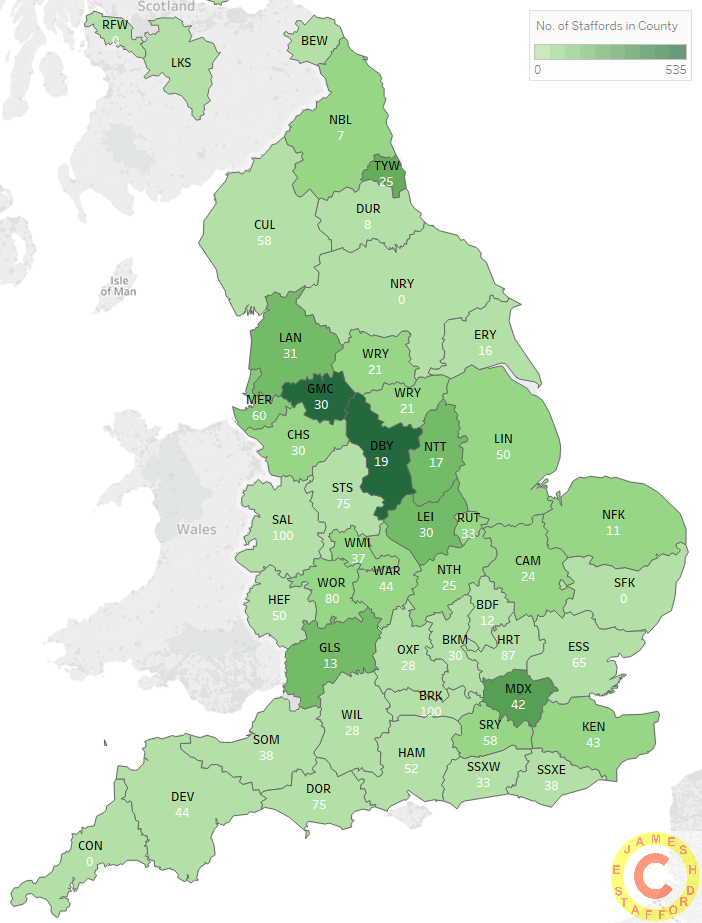 Figure 2. 1851 STAFFORD Distribution
Each county is identified by the associated Chapman code, and the number beneath the code represents the percentage of individuals born outside the county. Although Greater Manchester has the greatest occurrence of the STAFFORD surnames, the areas of Oldham (NNE Lancashire) and Stockport (NE Cheshire) within Greater Manchester comprise 83% and 72% of the total occurrences in the 1841 and 1851 censuses, respectively. There was almost a tripling of out-of-county born STAFFORDs in Derbyshire by 1851; of these some 90% originated in the bordering counties of Yorkshire, Cheshire, Lancashire, Staffordshire and Nottinghamshire. Of these, some 60% originated from Cheshire, 8% from Lancashire or Nottinghamshire, 7% from Leicestershire and 5% from Yorkshire or Staffordshire. Travel was not one way. Of those in Greater Manchester roughly one third were born in Derbyshire. A similar proportion born in Derbyshire could be found in Nottinghamshire, but only one individual moved as far as Leicestershire.
In the majority of cases the out-of-county born Derbyshire STAFFORDs were young families i.e. adults under 41 with children. In 10% of the cases they had moved with their elderly parents from Cheshire or Yorkshire.
Caveats
The main sources for error in the analysis are derived from miss-recording of the surname, place of birth and differences between the historical and ceremonial county boundaries used to aggregate the data. The impact is considered to be insignificant.
Only the STAFFORD surname was extracted and no adjustment was made for misspelling or incorrect recording by the enumerator. If the 1851 search is expanded to include variants ST*FF*RD and STRAFFORD for the whole of England an increase of 18.9% in hits is found, but only an increase of 2% for those born in Derbyshire.
With respect to place of birth, the place where the individual was brought up was probably more likely to be remembered and recorded, than their place of birth. This might be particularly relevant where the household did not include elderly parents viz., access to family knowledge.
Mapping the data proved more challenging as the availability of appropriate tools is limited or technically challenging. However, the availability of suitable ceremonial English county mapping data set [1] enabled construction of the STAFFORD distribution maps as an example. Although the boundaries of the ceremonial counties of England may not be the same as the historical boundaries, the impact on the number of STAFFORD individuals is considered to be small, except where significant changes could be identified e.g. creation of new ceremonial counties of Greater Manchester, Merseyside and West Midlands. In these cases the search was carried out on the constituent Registration Districts and the data subtracted from the appropriate county totals. Where the historical county was divided e.g. Sussex the surname frequency was split proportionally between the new ceremonial counties.
[1] The Information Lab. http://www.theinformationlab.co.uk/
 Print
Print 